

Insurance Technology
What Is Usage-Based Insurance (Telematics) and How It’s Tracked
Sep
Somewhere in your glovebox or buried in your phone’s app list, there might already be a small piece of technology quietly reporting how hard you brake, how fast you take corners, and what time of night you tend to drive. It sounds a little unsettling described that way, but for millions of American drivers, this is simply how their car insurance premium gets calculated now. Usage-based insurance, often built on telematics technology, has moved from a niche experiment to a mainstream pricing option offered by nearly every major U.S. auto insurer. This article explains exactly what usage-based insurance is, how the tracking technology actually works, and what it means for your privacy and your premium.
What Is Usage-Based Insurance?
Usage-based insurance, often abbreviated as UBI, is an auto insurance pricing model that calculates part or all of your premium based on how, how much, and sometimes when you actually drive — rather than relying solely on traditional demographic and historical factors like age, location, and past claims. Instead of assuming risk based purely on statistical averages for people similar to you, UBI programs collect real driving data and use it to build a more personalized risk profile.
This approach is often marketed under names like “pay-how-you-drive,” “pay-as-you-go,” or specific branded program names offered by individual insurers, but the underlying concept remains consistent: your actual behavior behind the wheel becomes a meaningful input into your insurance pricing.
A Brief History of Telematics in Auto Insurance
Usage-based insurance isn’t actually a brand-new idea, even though it feels like a recent development to many drivers. Early telematics programs date back to the early 2000s, when insurers first began experimenting with plug-in devices to collect basic mileage and speed data. Adoption remained fairly limited for years, largely due to the extra hardware requirement and consumer hesitancy around vehicle tracking. The shift toward smartphone-based tracking over the past decade removed much of that friction, since nearly every driver already carries a capable sensor-equipped device in their pocket, which is a major reason usage-based insurance adoption has accelerated so significantly in recent years.
The Technology Behind Telematics Tracking
Smartphone-Based Tracking
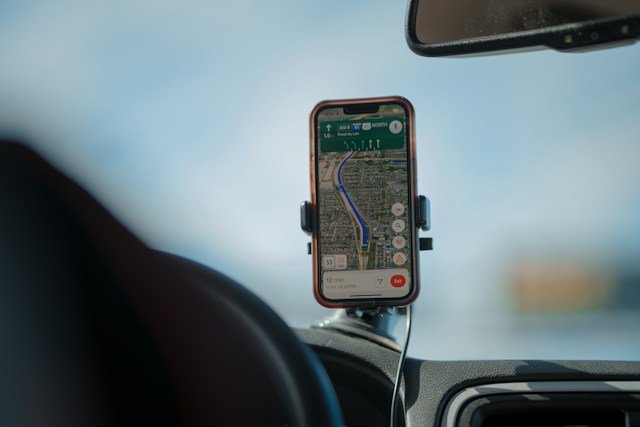
The most common modern approach uses a dedicated smartphone app that runs in the background while you drive, using the phone’s built-in GPS, accelerometer, and gyroscope sensors to detect movement patterns like acceleration, braking force, cornering speed, and phone handling while the vehicle is in motion. This approach has become popular because it requires no additional hardware — just downloading an app and granting the necessary permissions.
Plug-In OBD-II Devices
Some programs, particularly earlier telematics offerings, use a small physical device that plugs directly into your vehicle’s OBD-II port — the same diagnostic port a mechanic uses to read engine codes. This device pulls data directly from your car’s onboard systems, including speed, mileage, and sometimes more detailed engine diagnostics, then transmits that data to the insurer, typically via a built-in cellular connection.
Built-In Connected Car Systems
Increasingly, newer vehicles come equipped with manufacturer-installed connected car technology capable of collecting and transmitting driving data directly, without requiring a separate app or plug-in device at all. In these cases, automakers sometimes partner directly with insurance companies to offer usage-based programs built around data the car itself is already generating.
| Tracking Method | How It Works | Common Use Case |
|---|---|---|
| Smartphone app | Uses phone sensors (GPS, accelerometer) to detect driving behavior | Most widely used method today |
| OBD-II plug-in device | Physical device reads data directly from the vehicle’s onboard computer | Common in earlier or dedicated telematics programs |
| Built-in connected car system | Manufacturer-installed technology transmits data without extra hardware | Growing among newer vehicle models |
What Specific Data Gets Collected
- Hard braking events: Sudden, forceful braking is generally treated as a risk indicator.
- Rapid acceleration: Aggressive speeding up from a stop or while driving.
- Cornering speed: How sharply and quickly you take turns.
- Speed relative to posted limits: Some programs track how often and how significantly you exceed speed limits.
- Time of day driven: Late-night driving is statistically associated with higher accident risk in many models.
- Total mileage: Less driving generally correlates with lower overall risk exposure.
- Phone handling while driving: Some newer programs specifically attempt to detect phone usage or handling while the vehicle is in motion, as a proxy for distracted driving.
A Practical Example: Imagine two drivers, both signing up for the same usage-based insurance program. Driver A mostly commutes during daylight hours, brakes smoothly, and rarely exceeds posted speed limits. Driver B frequently drives late at night, brakes hard at intersections, and takes corners aggressively. Even if both drivers have identical driving records and no accidents on file, the telematics data collected over a typical 30 to 90 day monitoring period would likely place Driver A in a lower risk category, potentially resulting in a meaningfully lower premium adjustment than Driver B receives, purely based on observed behavior rather than historical record alone.
How the Data Actually Translates Into Your Premium
Once collected, driving data typically feeds into a scoring algorithm that converts raw behavioral metrics into a single risk score or a set of weighted risk indicators. Insurers then apply this score as a discount or surcharge on top of your base premium, which is still calculated using traditional factors. In most programs, the specific weighting of each factor — how heavily hard braking counts compared to late-night driving, for example — is proprietary to each insurer, though most publicly emphasize that safer, smoother, less aggressive driving generally leads to a more favorable outcome.
Discount-Only vs Bidirectional Programs
It’s worth understanding that not all usage-based programs work the same way when it comes to potential downside risk. Some programs are structured as discount-only, meaning your score can only reduce your premium or leave it unchanged, never increase it above your original quote. Other programs are bidirectional, meaning particularly risky observed driving behavior could actually result in a higher premium than you would have otherwise received. Understanding which structure a specific program uses before enrolling is genuinely important, since the potential downside differs significantly between the two models.
“Usage-based insurance shifts the underlying question from ‘what does someone like you typically do’ to ‘what did you actually do behind the wheel.’ For safe, low-mileage drivers, that shift usually works in their favor.”
Who Tends to Benefit Most From Usage-Based Insurance
- Low-mileage drivers: People who drive infrequently or work from home often see meaningful savings, since less time on the road generally means lower statistical risk exposure.
- Drivers with smooth, predictable habits: Consistent, non-aggressive acceleration and braking patterns tend to score favorably.
- Primarily daytime drivers: Since late-night driving often carries a statistically higher risk weighting, drivers who rarely drive after dark may see a more favorable score.
- Younger drivers with genuinely safe habits: Usage-based programs can sometimes offer a path to lower rates for younger drivers who would otherwise be priced primarily based on age-related risk averages, regardless of their individual driving quality.
Who Might Not Benefit as Much
- High-mileage commuters: More time on the road statistically increases exposure to risk factors the algorithm is measuring.
- Drivers in dense urban traffic: Frequent stop-and-go conditions can sometimes trigger more hard-braking events than would occur in lighter traffic, even with cautious driving.
- Shift workers with irregular late-night schedules: Programs that weight time-of-day heavily may not fully account for necessary, unavoidable night driving tied to a person’s job.
Privacy Considerations With Telematics Programs
Because usage-based insurance inherently involves collecting detailed behavioral and location data, privacy is a legitimate and frequently raised concern. Most U.S. insurers offering these programs are required to disclose what specific data is collected, how it’s used, and typically how long it’s retained, usually within the program’s terms and privacy disclosures. It’s worth reviewing these details directly before enrolling, particularly around whether collected data could be shared with third parties, used for purposes beyond insurance pricing, or retained after you cancel the program.
How Insurers Use Telematics Data Beyond Pricing
While premium calculation is the most visible use of telematics data, some insurers also use aggregated driving data for broader purposes, such as identifying high-risk intersections or road segments across their customer base, refining their overall underwriting models with more current behavioral data, or offering optional safety feedback directly to drivers through the same app, such as post-trip summaries highlighting specific hard-braking or speeding events. This secondary use is generally covered under the same privacy disclosures governing the primary pricing use of the data, though the specifics can vary by insurer.
Can You Opt Out After Enrolling?
Most usage-based insurance programs are entirely optional, and drivers can typically opt out or stop participating at any point, usually reverting to a standard, non-telematics-based premium calculation. However, specific policies vary by insurer, and some programs structure enrollment with a defined monitoring period before the discount or surcharge is finalized, so reviewing the specific program’s terms before opting in is worth the extra few minutes.
How Usage-Based Insurance Differs From Pay-Per-Mile Insurance
It’s worth briefly distinguishing usage-based insurance from a related but distinct product: pay-per-mile insurance. While usage-based programs typically adjust a standard premium based on driving behavior, pay-per-mile insurance charges a base rate plus a per-mile fee, calculated purely on how much you actually drive, regardless of how you drive. Some insurers combine elements of both approaches, but understanding which model a specific program follows helps clarify exactly what’s being measured and how it affects your bill.
| Feature | Usage-Based Insurance | Pay-Per-Mile Insurance |
|---|---|---|
| Primary factor | Driving behavior (braking, speed, time of day) | Total miles driven |
| Best suited for | Safe, smooth drivers regardless of mileage | Low-mileage drivers regardless of driving style |
| Pricing structure | Base premium adjusted by behavior score | Base rate plus per-mile charge |
How to Decide Whether to Try a Usage-Based Program
- Review your typical driving habits honestly — smooth, moderate, mostly daytime driving tends to perform best.
- Check whether the program is discount-only or bidirectional before enrolling, to understand your potential downside.
- Read the data privacy disclosure to understand exactly what’s collected and how it’s used.
- Consider your typical mileage, since lower annual mileage often correlates with a more favorable outcome across most programs.
- Ask about the monitoring period, since most programs require several weeks of data before finalizing any rate adjustment.
- Test it for one policy term before committing long-term, since most programs allow you to evaluate the actual savings against your specific driving pattern before deciding whether to continue.
The Future of Telematics-Based Insurance
As connected vehicle technology becomes more standard across new car models, usage-based insurance is likely to become an increasingly default option rather than an opt-in add-on, particularly as automakers deepen direct data-sharing partnerships with insurers. At the same time, growing consumer and regulatory attention to data privacy is likely to continue shaping exactly how transparent insurers must be about what’s collected and how long it’s retained, creating an ongoing balance between more personalized, potentially fairer pricing and reasonable data privacy expectations.
Some industry analysts also anticipate a gradual shift toward insurers offering usage-based pricing as the default quote option, with traditional, behavior-blind pricing becoming the opt-in alternative instead. Whether that shift happens quickly or gradually will likely depend heavily on how consumer comfort with data sharing evolves alongside the underlying tracking technology itself.
When Professional Guidance Might Help
- If you’re unsure whether a specific usage-based program is discount-only or could increase your premium
- If you have specific privacy concerns about location or behavioral data collection
- If you’re comparing usage-based, pay-per-mile, and traditional insurance pricing for your specific driving pattern
Frequently Asked Questions (FAQ)
Does usage-based insurance track my exact location at all times?
Most programs collect GPS-based location data primarily to calculate mileage, speed relative to road type, and time of day, rather than continuously monitoring your exact destinations. Specific data handling varies by insurer, so reviewing the program’s privacy disclosure is the most reliable way to understand exactly what’s tracked.
Will using a smartphone app for tracking drain my battery?
Continuous GPS and sensor tracking can have some impact on battery usage, though most modern telematics apps are designed to minimize this, and the effect is generally comparable to other background location-based apps.
Can my premium go up because of usage-based tracking?
It depends on the specific program. Discount-only programs can only lower or maintain your rate, while bidirectional programs can potentially increase it based on observed risky driving behavior, so it’s worth confirming which type you’re enrolling in.
Do I have to keep the app or device active for my entire policy term?
Most programs only require an initial monitoring period, often 30 to 90 days, after which the resulting discount or adjustment is typically applied for a set period, though this varies by insurer and specific program structure.
Does usage-based insurance work the same way for every driver in a household?
Not necessarily. Some programs track data per individual driver if multiple people use the same vehicle, while others calculate a combined score based on all recorded trips regardless of who was driving, so it’s worth confirming how a specific program handles multi-driver households.
Is usage-based insurance available in every state?
Most major insurers offer some form of usage-based program in the majority of U.S. states, though specific program availability, structure, and whether it’s discount-only or bidirectional can vary depending on state insurance regulations.
Conclusion
Usage-based insurance represents a genuine shift in how auto insurance risk gets measured — moving from broad demographic assumptions toward actual, observed driving behavior collected through smartphone sensors, plug-in devices, or built-in connected car technology. For safe, moderate-mileage drivers, these programs often translate into meaningful savings, while drivers with riskier or higher-mileage habits may see less benefit, or in bidirectional programs, even a less favorable outcome. Understanding exactly what data gets collected, how it’s weighted, and whether a program carries any downside risk is the key to deciding whether letting your driving habits speak for themselves is the right move for your specific situation.